She Trained Me Better Than This

She Trained Me Better Than This

Notes on the small, daily art of being in a long relationship.

Contents.

  1. ForewordForeword
  2. IAbout the TitleCh. 01
  3. IIThe Zone (of Compromise)Ch. 02
  4. IIIThe Perfect StormCh. 03
  5. IVThe Very Right AnswerCh. 04
  6. VInvestigative PhaseLocked
  7. VI4Q SystemLocked
  8. VIIDo You See Me Gaining Weight?Locked
  9. VIIIReviewLocked
  10. IXThe Learning PhaseLocked
  11. XGiftsLocked
  12. XIDarn Valuable QuestionsLocked
  13. XIIReviewLocked
  14. XIIIOpinionsLocked
  15. XIVFashion & MakeupLocked
  16. XVYour WardrobeLocked
  17. XVICrying Is Okay, Complaining Is NotLocked
  18. XVIIHelping HerLocked
  19. XVIIIHer PassionsLocked
  20. XIXYour PassionsLocked
  21. XXSexLocked
  22. XXIJealousy (Hers)Locked
  23. XXIIJealousy (Ours)Locked
  24. XXIIIIs That All?Locked
Foreword
Foreword

Foreword


I started jotting down notes for this book back when I began dating the woman who would eventually become my wife.

Our love story is a special one, and maybe it deserves its own book someday. Since I didn’t have much dating experience under my belt, I figured it would be smart to put together a personal framework to help me avoid stepping on too many landmines. I hoped to dodge the big mistakes, but more often than not, I found myself drifting away from this guide and learning a few hard lessons the painful way.

There’s a line from Soren Kierkegaard that sounds so obvious that it hurts: “Life can only be understood backwards; but it must be lived forwards.” I think that captures the strange position any of us is in when we try to write about relationships. While you’re inside one, you can’t quite see the shape of what’s happening. Only later, when you look back, do the patterns reveal themselves. And this concept applies to love even more than it does to life in general. This book is my attempt to translate some of that backward-looking clarity into something you can actually use while you’re still moving forward.

My wife, definitely out of my league, I know

Despite all my missteps, our story turned into a beautiful family, and I was lucky enough to “win” my wife’s heart. That said, I want to be upfront about something: this book isn’t a cure-all for relationship troubles, and it doesn’t claim to be the definitive guide to understanding or building a great relationship with a woman. It’s simply an honest but structured reflection on my own experiences and the lessons I’ve picked up along the way. My hope is that by sharing what I’ve learned, readers might sidestep a few arguments and find their own relationships a little smoother.

I should also confess upfront: I’m not a relationship expert. I’m not a therapist, a psychologist, or a couples counselor. I’m a guy who got lucky enough to find a remarkable woman and stubborn enough to want to figure out how to keep her happy. That’s the entire qualification behind this book. If you came looking for credentials, you can close it now. If you came looking for the kind of practical wisdom one regular guy might share with another over a beer, you’re in the right place.

While the layout of this book might look like a formal manual, it isn’t based on rigorous research or empirical studies. It’s a mix of personal stories and reflections. Think of it less like a textbook and more like a long conversation. The kind you’d have with an older friend who has made every mistake worth making and is willing to share what those mistakes taught him, even the embarrassing ones.

Tolstoy famously opened Anna Karenina with the line: “Happy families are all alike; every unhappy family is unhappy in its own way.” I’ve come to suspect the opposite is also true. Happy couples are happy in their own quietly unique ways, while unhappy couples often stumble over the same handful of recurring problems. The patterns in unhappiness, the avoidable arguments, the misread cues, the slow drift caused by inattention, are what I’ve tried to map in these pages. Not because mapping them guarantees happiness, but because spotting them early gives you a real fighting chance. It’s also worth quoting a billionaire friend of mine. He always says that a good deal is when everybody is reasonably unhappy. And I don’t want to be the pessimist here, even though opening a paragraph with Tolstoy might give that impression. Unhappiness isn’t exactly the opposite of happiness. There could be a huge amount of happiness when some reasonable unhappiness is embraced.

I also want to make clear that this book is meant as a feminist manifesto. It’s not a playbook for “winning her over on the first night” or any other kind of gender-based manipulation. The whole self-improvement-for-men genre is, frankly, crowded with bad advice. There’s a strain of so-called “pickup” or “alpha” thinking that treats women as puzzles to be solved or obstacles to be overcome. That’s not what this is. The premise here is the exact opposite: women are not puzzles. They are full, complex, intelligent people, and the work of a relationship is the work of two adults learning each other deeply and choosing each other repeatedly.

My wife, who served as the first editor and reader of this manuscript, encouraged me to take what started as casual musings and shape them into something more structured. She caught the moments where my framing leaned a little too far toward “man explains women” and pulled me back. Anything in these pages that lands with humor or warmth probably has her fingerprints on it. Anything that falls flat is on me.

So that’s what this book is, ultimately. A record of someone’s attempt. Mine, specifically, but I hope yours becomes layered on top of it as you read.

I trust readers will approach this work with the same humor and lightheartedness in which it was written. Take what serves you. Leave the rest. And if you find that one chapter changes how you handle a single conversation with the person you love, then this whole project will have been worth the effort.

A few practical notes before we begin. The book is structured in three main phases, which I call the investigative, interactive, and proactive phases, plus a continuous thread called the learning phase that runs through all of them. Don’t worry if that doesn’t make sense yet. By the end of the third or fourth chapter, the framework will start clicking into place. Each chapter builds on the one before it, so I’d recommend reading them in order on your first pass. After that, treat the book like a reference. Flip back to specific chapters when a particular situation comes up.

One last thing. Throughout these pages, I use “she” and “her” and frame the partner as a woman, because that’s my own experience and I want to write honestly from where I stand. But most of the underlying principles, the attention, the listening, the proactive care, are universal to any committed relationship. If you’re reading this from a different vantage point, take whatever translates and ignore the rest.

Ok, very last thing. The book was originally written in 2022, but it went through a bit of rewriting and this is the new version, hopefully more enjoyable. AI helped my broken English, but the content is genuinely coming from my keyboard.

Enough with last things, welcome aboard, let’s get started.
Chapter I
Chapter I

About the Title


The title of this book, She Trained Me Better Than This, is the kind of thing a man says about himself the moment he catches a small mistake. He does something thoughtless, and he immediately knows better, because the woman in his life has, over years of quiet correction, taught him better. It’s half a confession and half a compliment. The confession: I slipped. The compliment: she’s the reason I usually don’t. That single sentence captured something I’d been trying to articulate for years.

The idea that a marriage is, among other things, a long and patient training isn’t mine and it isn’t new. People say it out loud all the time, usually as a joke. Barack Obama did, in public, on the record. On his and Michelle’s wedding anniversary in 2014, while visiting a steel plant in Indiana, he stopped to give a bit of unsolicited marriage advice to a newly married woman in the crowd: “It takes about 10 years to train a man properly, so you’ve got to be patient with him.” It got a laugh, because everyone in earshot recognized it instantly. And notice that the joke runs in both directions. The wife does the training; the husband, if he’s smart, lets himself be trained. The title of this book is simply the same joke told from the other side of the marriage. Not be patient while I learn, but look, I learned, and she’s the reason.

Say that line, she trained me better than this, and three things are happening at once.

First, there’s the ownership of a small mistake. Most men, when they make a minor relationship misstep, default to one of two responses: deny it ever happened, or get defensive when it’s pointed out. The posture in that sentence does neither. It admits the slip. It takes the L. That kind of casual accountability is rarer than it should be.

Second, there’s the credit being directed outward. “She trained me better than this.” Not “I’m just a thoughtful guy” or “I always pay attention to details.” It hands the woman the credit for the better instinct he was failing to live up to. That’s a small linguistic move with a big philosophical payload. It acknowledges that becoming a better partner is, in part, a result of having a partner who notices, who cares, and who gently raises the bar.

Third, there’s the humor. There’s a lightness to it, a man cheerfully roasting himself rather than mounting a defense. The lightness signals confidence. He isn’t groveling. He’s smiling.

I think a lot of men struggle with at least one of those three ingredients. Some can’t admit the mistake. Some can’t give the credit. Some can’t bring the humor. Getting all three working at once, in the right proportions, in a way that feels natural rather than performative, is a skill. And like any skill, it can be learned.

Sigmund Freud once wrote: “The great question that has never been answered, and which I have not yet been able to answer, despite my thirty years of research into the feminine soul, is ‘What does a woman want?’” It’s a famous quote, and it’s also, in my view, the wrong question. That line on the cover suggests a better one. The better question isn’t what does she want? It’s what has she been teaching me, slowly and patiently, that I should have been paying attention to all along?

The title is a kind of haiku of modern marriage. Brief, self-aware, affectionate, and a little bit funny at the husband’s own expense. It says: yes, I’m a grown man with a career and opinions and preferences of my own, and I’m also someone who is being gently shaped by the woman I chose to share my life with. Those two things are not in tension. They’re the whole point.

David Foster Wallace’s commencement speech “This Is Water” says: “The really important kind of freedom involves attention, and awareness, and discipline, and effort, and being able truly to care about other people and to sacrifice for them, over and over, in myriad petty little unsexy ways, every day.” That, to me, is what training looks like inside a relationship. Not training in the sense of a dog learning tricks, but training in the sense of an athlete sharpening their craft. Repetition, attention, small adjustments, day after day.

So that’s the spirit of this book, compressed into six words on the cover. The willingness to be visibly shaped by your partner. The willingness to laugh about it. The willingness to say, out loud: she’s been training me, and I’m grateful.

That’s the energy I tried to bring to the rest of these pages. If anything in this book lands flat or feels too earnest, remember those six words, she trained me better than this, and recalibrate accordingly.

Chapter II
Chapter II

The Zone (of Compromise)


Socrates is often cited as having picked a difficult wife on purpose. The logic goes: “to become a great horseman, one must learn to tame the wild horse.” Nietzsche, on the other hand, suggested that Socrates’ choice of Xanthippe was a deliberate demonstration of exactly what a philosopher should avoid: marriage and all its distractions.

Whether either story is true is up for debate, but one thing is clear: for those of us who aren’t philosophers and don’t aspire to be, relationships, particularly with women, are very much a journey of growth and learning.

Diogenes Laertius, writing centuries after Socrates’ death, claimed the philosopher once said of his troubled marriage: “By all means, marry. If you get a good wife, you’ll become happy; if you get a bad one, you’ll become a philosopher.” Whether the line is real or invented, it captures something true about how relationships shape us. Either way, we end up changed.

The kind of partner we have can shape the intensity and challenges of our journey, sometimes to the point where the relationship simply can’t continue. On the flip side, an intense early phase of learning and adapting can sometimes lead to a surprisingly stable long-term relationship. Couples I’ve watched fight their way through their first two years together often look, a decade later, like the most rock-solid partnerships of anyone I know. They earned their stability by paying the tuition early.

Every relationship is unique, and each one deserves to be fully understood, interpreted, and lived on its own terms. There’s no universal template. Anyone who tells you otherwise is selling something, usually a course (or a book).

The Two Worlds

Before we get to the obvious diagram, let’s set up the picture. Imagine, for a moment, that you and your partner each arrive in this relationship carrying an entire world. Not just opinions and preferences, but childhood memories, family expectations, scars, beliefs about how love is supposed to look, ideas about money, food, holidays, in-laws, how to load a dishwasher. The whole accumulated weight of who you’ve been until now.

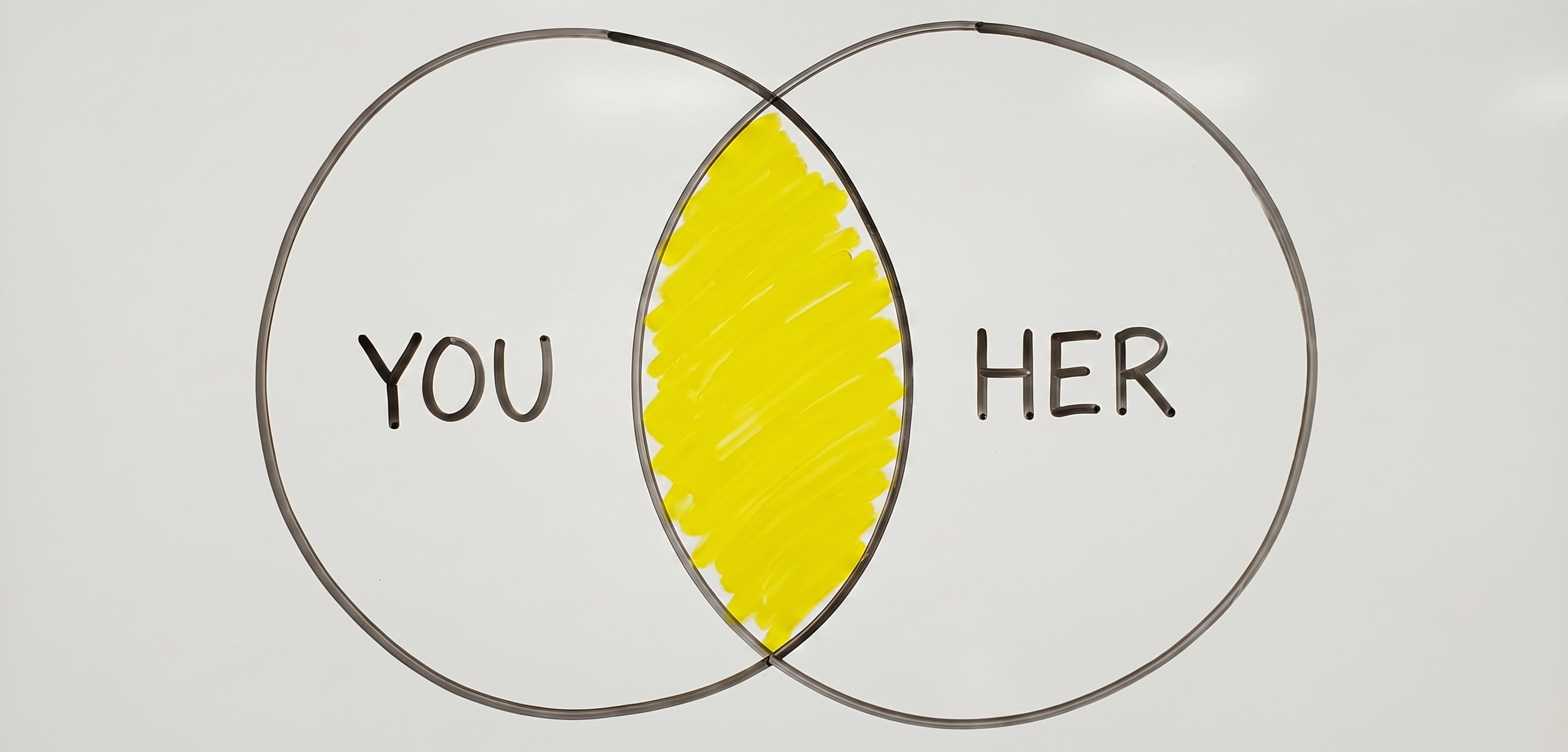
When two people commit to a life together, those two worlds don’t merge into one. That’s the myth. Pop songs and rom-coms promise that “the two become one,” and it sounds beautiful, but it isn’t quite right. What actually happens is much more interesting. The two worlds overlap. They create a shared zone in the middle while leaving plenty of each individual world standing on its own.

That overlap is what I want to focus on.

Any thriving relationship can be visualized with a diagram like this. The middle area, or the zone of compromise, might lean a little more toward one partner than the other, but both people need to give a little ground. The relationship lives inside that shaded space.

Reading the Zone

When we look more closely at the zone of compromise, it can sometimes appear (at least based on the relationships I’ve observed) that the man tends to make more of the concessions. But this dynamic can shift quite a bit from one couple to the next. I’d caution against turning this observation into a grievance. The goal isn’t to keep score of who compromised more this week. The goal is to make sure the zone exists at all and that it’s healthy.

A few things are worth noticing about the zone:

  • Its size. A larger overlap usually means more shared interests, values, and routines. A smaller overlap doesn’t necessarily mean a worse relationship, but it does mean the couple has to work harder to find common ground.
  • Its shape. Some couples have a wide, even overlap, where compromise is distributed across many areas of life. Others have a deeper but narrower overlap, where they agree intensely on a few key things and have largely separate domains otherwise. Neither is automatically better.
  • Its drift. Over time, the zone moves. New shared interests get added. Old ones fade. Children, jobs, illness, and aging all push and pull on the zone’s shape. The healthy thing isn’t to keep the zone fixed, but to keep paying attention to where it currently is.

When Compromise Isn’t Compromise

A small but important caveat. Not everything that looks like compromise actually is. There’s a version of “compromise” that’s really just one person quietly surrendering. They stop pushing for what they want, not because they’ve genuinely changed their mind, but because pushing has become too exhausting. From the outside, this looks like a couple in harmony. From the inside, it feels like erosion.

Carl Jung once observed: “The meeting of two personalities is like the contact of two chemical substances: if there is any reaction, both are transformed.” The key word is both. If only one of you is being transformed in the relationship, what you have isn’t compromise. It’s assimilation. And assimilation tends to build up resentment that explodes later, usually in ways neither partner sees coming.

Real compromise has a particular feeling. It’s the feeling of giving up something you genuinely wanted in exchange for something else you also genuinely wanted. Surrender, by contrast, feels like giving up something you wanted in exchange for nothing in particular, just an absence of conflict.

If you find that your version of “compromise” mostly involves you doing the giving up, that’s worth examining honestly. And vice versa.

You don’t manage your partner. You don’t try to control her. What you manage is the shared space, the zone where the two of you actually meet.

This overlapping space between you and your partner is the fertile ground where relationships grow. It’s where two worlds meet, sometimes in harmony and sometimes in conflict, but it’s where the foundation needs to take root. Everything else in this book, every framework, every technique, every awkward example involving lipstick or weight or jealousy, is really about one thing: tending that shared space. Making it bigger when bigger serves you. Letting it stay smaller when smaller serves you. But always, always, knowing exactly where it is.

In the chapters ahead, we’ll explore how these zones of compromise come into play across different parts of a relationship, from personal space to intimacy. We’ll look at how to expand the zone in healthy ways, how to defend the parts of yourself that legitimately live outside it, and how to spot the warning signs when the zone is shrinking or drifting in a direction neither of you actually wanted.

For now, just hold the image in your head. Two worlds. An overlapping zone. Two people, each with one foot in their own territory and one foot in the shared one. That’s the picture. The rest of the book is about how to keep that picture intact.

Chapter III
Chapter III

The Perfect Storm


In the last chapter, we kicked off a pseudo-scientific look at relationships between men and women. Before going any deeper, though, it’s worth circling back to the core philosophy that runs through this book.

It’s a pretty common feeling among men (at least I think so) to think of women as “superior beings,” not just physically but especially in the way their minds work. That inner world can leave a lot of us scratching our heads, and the search for understanding often ends in frustration. We try to apply logic. We try to “solve” the situation. We deliver what we believe is a watertight argument. And somehow, the conversation gets worse, not better. We end up confused, defensive, and convinced that we’re being misunderstood.

The frustration is real. But the frame is wrong.

The Captain and the Ocean

From where I sit, and I think you might agree, a man’s most practical approach is to think like a seasoned ship captain navigating the open ocean. The captain respects the sea. He knows full well he can’t command it.

Instead, he learns to read the signs of an approaching storm and adjusts course to steer clear of trouble. He doesn’t blame the ocean for being wet. He doesn’t try to convince the wind to blow the other way. He doesn’t stand on the bow shouting at the waves about how unfair they’re being. The ocean simply is, and his job is to navigate it skillfully.

This is the single most useful reframe I can offer you. Your partner isn’t a problem to be solved. She’s an environment to be navigated. And like any environment, she has weather. Some days are sunny and clear. Other days a storm rolls in for reasons that might have nothing to do with you. Your job isn’t to control the weather. Your job is to be a good captain.

There’s a Stoic teaching from Epictetus that has always seemed to me to apply directly to this idea: “It’s not what happens to you, but how you react to it that matters.” You can’t choose the weather of your partner’s day. You can absolutely choose how you respond to it.

Adopting that mindset can make relationships a lot simpler, helping us avoid storms we didn’t see coming. But this doesn’t mean we should give up who we are just to keep the peace. A captain who is afraid of every cloud and changes course at the first hint of wind never actually goes anywhere. As we’ll see together, a relationship is a delicate balance, and the goal we’re aiming at is mutual happiness, not just the absence of conflict.

What “Superior Being” Actually Means

I used the phrase “superior being” earlier, and I want to be careful with it, because it can land wrong. I don’t mean that women are objectively better than men or that men should defer to women in all things. I mean something more specific.

Most women, in my observation, have access to a richer emotional vocabulary, a sharper read on social dynamics, and a more developed sense of how small actions compound into long-term feelings. These aren’t mystical gifts. They’re skills, often built through a lifetime of social experience that men, on average, simply haven’t had in the same way. When we treat these skills as superpowers we’ll never understand, we let ourselves off the hook. When we treat them as observable patterns we can learn from, we start to grow.

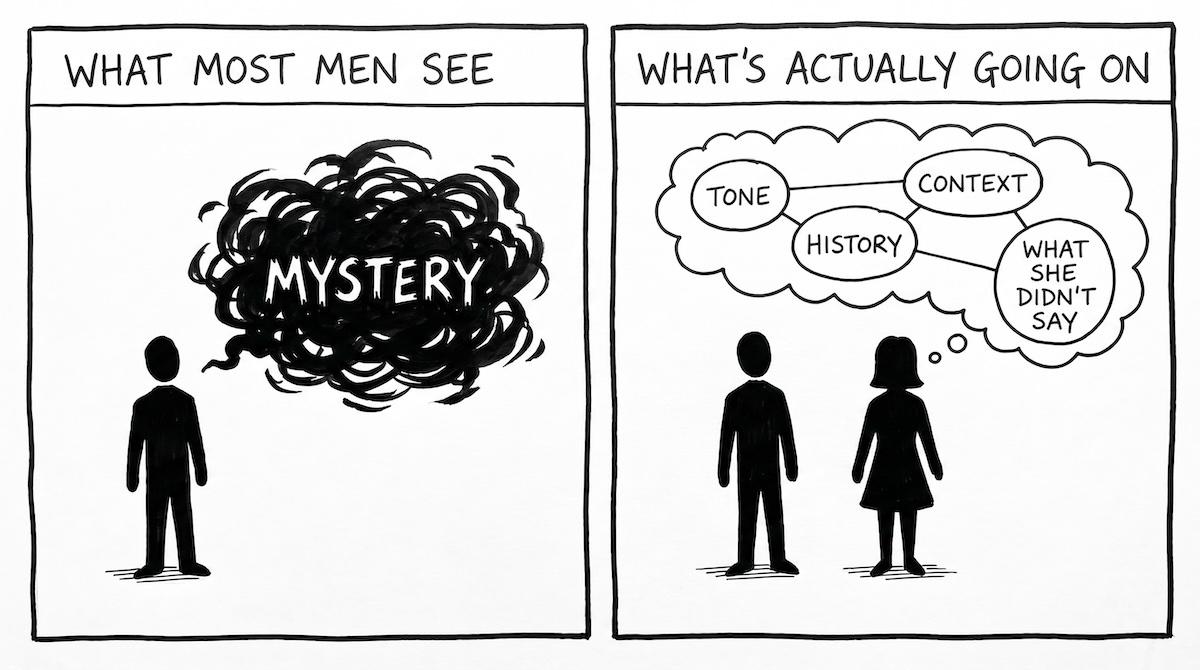
Most of the “mystery” of a relationship is really just unconscious patterns we haven’t yet learned to see. Calling them mysterious is comfortable. Learning them is harder, but it’s the actual work.

Flipping the Storm

To flip the script, a move we’ll come back to often in later chapters, we can look at the “perfect storm” as a transformative moment of clarity. The saying goes that we learn more from our failures than our successes, and the size of our setbacks often shapes the size of the growth that follows.

There’s an old Japanese proverb: “Fall down seven times, get up eight.” The wisdom isn’t in the falling, and it isn’t even quite in the getting up. It’s in the implication that each fall builds the muscle that makes the next getting-up possible. If you’ve never fought through a real storm in a relationship, you don’t yet know what you and your partner are made of. The storms tell you.

Think back to the toughest moments in your relationships. The fight that lasted three days. The misunderstanding that almost ended things. The night one of you said something neither of you could take back, and you had to find a way to put it back together anyway.

When did you really grow as a person? I’d bet it was when you failed.

The fights you keep having, the patterns that keep recurring, the same argument in a slightly different costume, those aren’t curses. They’re tutors. They keep showing up because there’s still something to learn.

The Lessons That Stick

No matter where you are on your romantic journey, whether you’re picking up the pieces of a tough breakup at 20 or working through your third marriage with a few storms behind you, every experience has something to teach. These lessons shape us into better people and better partners, but only if we’re open to what they’re trying to tell us and willing not to repeat the same mistakes.

A few warnings about how this kind of learning works, though.

First, you can’t shortcut it. You can read every relationship book ever written, including this one, and you still won’t have the wisdom until you’ve earned it through actual lived experience. Books accelerate the process. They don’t replace it.

Second, the lessons rarely arrive in a neat package. They’re usually messy, incomplete, and a little embarrassing. You’ll be folding laundry six months after a fight and suddenly realize what she was actually upset about. That’s how it works. Be patient with yourself.

Third, some of the lessons will sting. There’s a moment in the film Good Will Hunting where Robin Williams’ character tells Matt Damon: “You’ll have bad times, but they’ll always wake you up to the good stuff you weren’t paying attention to.” The bad times aren’t the enemy of the relationship. They’re often the thing that forces you to finally see the good times for what they are.

The metaphor I keep coming back to isn’t actually the storm. It’s the spiral. Relationships don’t move in a straight line from problem to solution. They move in a spiral, where the same issues keep coming around, but each time at a slightly higher level. You face the same kind of conflict at year seven that you faced at year one, but if you’ve been paying attention, you handle it with more skill, more grace, and more love. That’s growth.

So when the next storm rolls in, and it will, try to remember the captain. Don’t argue with the ocean. Read the wind. Adjust your course. And after the storm passes, take a quiet moment to ask yourself what it was trying to teach you. The answer will be worth more than anything I’ve written in this book.

Chapter IV
Chapter IV

The Very Right Answer


Let’s shift from abstract philosophy to something you can actually use. The next several chapters, this one included, will dig into the framework with hands-on examples. For the best experience, I’d recommend reading these chapters in order, since each one builds on the one before.

We’re starting with the art of conversation. Specifically, the differences between three possible responses:

  • The wrong answer.
  • The right answer.
  • The very right answer.

Before we dive in, I want to stress that what I’m sharing here isn’t a manipulation tactic or some kind of shortcut. The goal is to understand these types of responses, not to wield them as weapons to “win” conversations, but to show your emotional intelligence and your attentiveness as a partner. If you read this chapter and walk away thinking “great, now I can fake my way through any tough question,” you’ve missed the whole point. The very right answer isn’t a magic phrase. It’s a habit of attention that produces good phrases naturally.

The Lipstick Example

Take the question: “Do you like my lipstick?”

Sit with it for a second. Chances are good you’ve heard some version of this before. Maybe not lipstick specifically, but the structural cousin of it. “Do you like this dress?” “What do you think of my new haircut?” “How does this color look on me?”

These are not trick questions. They’re not tests. They’re not setups. They’re invitations into a small moment of shared attention, and how you respond shapes the moment.

There are three basic ways to respond, regardless of what you actually think:

  • The right answer: “Yes, I like it.”
  • The wrong answer: “No.”
  • The very right possible answers:
  • “Yes, it really complements your complexion!”
  • “Absolutely, you should wear it more often!”
  • (If you remember the details) “Of course! We picked it out together at [store] on [date], right? I wasn’t sure about it then, but now I see it looks fantastic on you.”

Let me walk through why each of these lands the way it does.

The “no” is wrong not because honesty is wrong, but because the form of the answer mismatches the form of the question. She didn’t ask you for a yes-or-no verdict on the lipstick. That’s what your brain heard, but it isn’t what she said. We’ll get to validation questions in a later chapter, but for now, just notice that she’s offering you a moment, and a “no” slams the door on it.

The “yes, I like it” is technically correct. It’s a passing grade. It won’t start a fight. But it also won’t build anything. It’s the conversational equivalent of nodding while looking at your phone. She’ll register it, and she’ll move on, and she won’t think about it again. That’s the problem. Nothing was built.

The three very right answers all do something the first two don’t: they show that you’re engaged. The first one notices something specific (the way it works with her complexion). The second one frames it as a recommendation for the future, which signals you’ve actually thought about it. The third one ties it to a shared memory, which is the highest level of engagement available, because it folds in the whole history of the two of you.

What a Very Right Answer Actually Is

So what makes an answer a very right answer? It’s a response that doesn’t just answer the question. It shows that you’re engaged with the topic and brings a positive feeling to your partner.

I want to be more precise about that, because “engaged” is a slippery word.

A very right answer has three properties:

  1. It’s specific. Not generic praise, but a particular observation. “It complements your complexion” is specific. “It looks good” is not.
  2. It demonstrates attention. The response could only have been given by someone who was actually paying attention to her, not just to the words of the question.
  3. It creates a small moment of warmth. She walks away from the exchange feeling slightly better than she did before she asked.

If your answer hits all three, it’s a VRA. If it hits two, it’s a solid right answer. If it hits zero or one, you’re probably in wrong-answer territory, regardless of how technically correct your response was.

Getting comfortable with the very right answer is, in my view, foundational to a healthy relationship. The aim is to build the instinct to deliver these answers naturally, without having to overthink them. The first few weeks of consciously practicing this, it will feel a little forced. That’s normal. After a few months, you won’t notice you’re doing it anymore. After a year, your partner won’t either, except in the quiet, accumulated sense that she feels seen by you.

There’s an Maya Angelou quote that gets passed around so often it’s lost some of its weight, but it’s worth recovering: “I’ve learned that people will forget what you said, people will forget what you did, but people will never forget how you made them feel.” The very right answer is essentially a tool for making someone feel seen, and feeling seen is one of the things human beings remember longest.

The Layer Underneath

But before we get into the mechanics of crafting these responses, we need to look at the deeper layer behind questions like this.

Back to the lipstick example: what’s really going on underneath that seemingly innocent question? In all likelihood, she likes the lipstick. She picked it out. She bought it. She decided to wear it today. So she’s not really looking for a neutral review. She already has her own opinion. She’s looking for validation and connection.

This is where a lot of men go wrong. We hear a question and we treat it as a request for information, when it’s really a request for connection. The question is the doorway. What’s on the other side of the doorway is the moment, and what she actually wants is to share the moment with you.

Fleabag built a whole TV show out of exactly this mismatch. Phoebe Waller-Bridge’s character keeps asking ordinary-sounding questions while the camera (and the audience) can see the layer underneath she’s actually pointing at. The boyfriend who can read that layer is rare. The whole show is, in a way, about him not existing yet. Train for it.

What she’s really doing, when she asks about the lipstick, is offering you a small opportunity to add something to her poetic memory. A flat answer adds nothing. A very right answer adds a sentence she’ll remember a year from now, even though neither of you will be able to say why.

When the Wrong Answer Is the Right Answer

One more nuance, because I don’t want to make this too clean. Sometimes the right answer really is honesty, even if it stings a little. A relationship built entirely on very right answers can start to feel rehearsed. There has to be room for the genuine, slightly imperfect, real-time response.

The trick is in the frame. Compare these two ways of saying “no, I don’t love this lipstick”:

  • “No, I don’t like it.” (Flat. Dismissive. Closes the door.)
  • “Honestly, I think the one you wore last weekend was even better. This one’s nice, but that one really lit you up.” (Honest, but framed as a comparison that still pays a compliment.)

Both communicate that you prefer something else. Only one of them builds the relationship while doing it. The second answer respects her enough to be honest, and respects her enough to be thoughtful about how the honesty lands. That’s the move.

The Framework

Now let’s bring in a framework that will help us organize and understand the many concepts we’ll be exploring together. Throughout the rest of the book, every technique, every tool, every example will slot into one of four phases:

  • Investigative Phase — gathering information about your partner’s current state.
  • Interactive Phase — responding skillfully to what’s happening in real time. This is where the VRA lives.
  • Proactive Phase — initiating thoughtful actions before they’re asked for.
  • Learning Phase — the continuous thread that runs through all three, where you’re constantly updating your understanding of who she is.

We’ll fill in this framework with topics and sub-frameworks in the chapters ahead. For now, just notice that the very right answer sits in the Interactive Phase. It’s something you do in the moment. But notice also that you can’t deliver a real VRA without information from the Investigative Phase (“how is she doing right now?”) and the Learning Phase (“what does she actually like?”). The phases are tools in isolation, but they only really work when they’re operating together.

That’s the whole game, in fact. Investigate. Learn. React skillfully. Initiate thoughtfully. Repeat for the rest of your life. The chapters ahead are just ways of getting better at each one of those four things.