A practical relationship book for husbands
You love her.
You are genuinely trying.
So why does she still feel alone?
For men who work, provide, help, stay loyal — and still hear the same handful of sentences.
3 chapters free, no signup instant unlock also on Kindle
- You don’t listen to me.
- You never notice.
- I shouldn’t have to ask.
- I feel like we’re just roommates.
And the most confusing one of all:
“I know you love me. I just don’t feel it anymore.”
She Trained Me Better Than This is not another book telling you to agree with everything your wife says, apologise for existing, or spend the rest of your marriage walking on eggshells.
It is a practical, honest, occasionally uncomfortable, and often funny guide to understanding what keeps going wrong in the small moments that shape a long relationship — so your effort has a better chance of actually reaching the person you love.
There is no therapy language here, and no collection of phrases designed to manipulate your wife into calming down. It is definitely not a “happy wife, happy life” book either, and it does not pretend every woman is the same.
Just one husband sharing what he learned after years of getting some things right, plenty of things wrong, and finally paying closer attention.
Let me guess what has been happening
You work and handle responsibilities. You pay bills, solve problems, take care of the children, arrange repairs, carry things, drive people where they need to go, and step in when something has to be done.
You may genuinely believe you are doing more than many husbands you know. You are not disappearing for days, not cheating, not wasting the family’s money, not consciously trying to make your wife feel unimportant.
And yet she tells you she feels unsupported, unseen, emotionally alone.
Naturally, your mind begins producing evidence:
- What about everything I did this week?
- What about the hours I worked?
- What about the children I handled?
- What about the bills I paid?
- What about the problem I fixed before anyone else even noticed it?
- How can she say I do not care when so much of my life is built around taking care of this family?
- You explain. She hears defensiveness.
- You list everything you have done. She hears that you are trying to prove her feelings are incorrect.
- She becomes more upset, because she does not feel understood. You become more upset, because you believe your love and effort are being erased.
Five minutes later, the original issue has disappeared.
Now you are arguing about whether you care at all.
And you are standing there thinking:
How did we get from one forgotten conversation to the entire history of our marriage?
Here is the part nobody explains properly
You are measuring your effort.
She is measuring her experience.
You remember working hard
She remembers feeling alone while you worked
You remember being in the same room all evening
She remembers that you barely looked up from your phone
You remember offering a solution
She remembers trying to tell you she was overwhelmed and leaving the conversation feeling even more alone
You remember avoiding an argument
She remembers the moment you emotionally disappeared
You remember helping
She remembers having to notice the problem, ask you, explain the task, answer your questions, and check whether it was finished
You may both be describing the same relationship honestly.
That is what makes it so difficult. You are looking at what you tried to give. She is living with what reached her.
That is the problem this book was written to solve.
The book
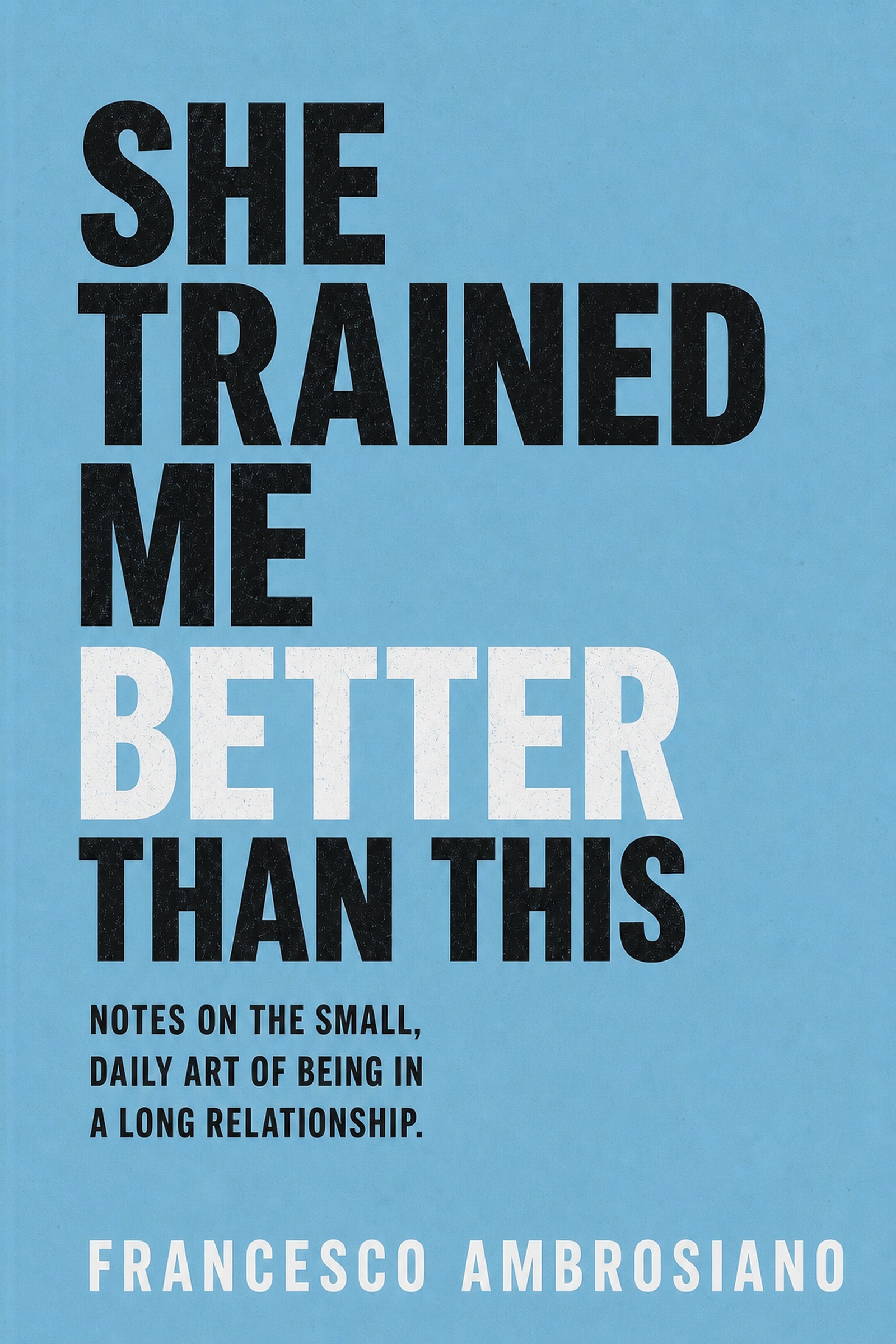
She Trained Me
Better Than This
Notes on the small, daily art of being in a long relationship
Inside, you will learn how to
- recognise what the moment may really be about before you react;
- acknowledge impact without pretending your intention does not matter;
- ask better questions instead of guessing or reading minds;
- help without automatically trying to fix everything;
- make the love you already feel easier for her to experience.
Not scripts. Not therapy language. Just practical distinctions you can use in ordinary conversations.
Arguments are rarely about what you’re arguing about
She tells you about a terrible day at work.
You immediately start thinking of ways to fix it.
She was not looking for a solution. She wanted to know you understood how embarrassing — or unfair, or exhausting — it felt.
She gets upset because you forgot something she mentioned a few days ago.
You are thinking, “It was such a small thing.”
She is thinking, “If it mattered to me, why didn’t it stay with you?”
She says, “We never spend time together.”
You think, “We have been in the same house all weekend.”
But being in the same room is not the same as feeling like you are together.
That is why arguments can start over something tiny and suddenly become about much more. The small thing is often just where the larger feeling finally came out.
When every answer becomes the wrong answer
- You offer advice. She says you weren’t listening.
- So next time you listen quietly. Now she wants to know why you have nothing to say.
- You give her space, because you don’t want to make things worse. She feels like you walked away.
- You ask what’s wrong. She says, “Nothing. I don’t want to talk about it.”
- You believe her. Later she tells you she was hoping you’d come after her.
- You explain what you meant. It sounds defensive.
- You apologise before you even understand what happened. Now the apology feels empty.
After a while, you stop reacting naturally. Before you say anything, you’re already wondering how it’ll be received.
You think twice before making a joke. You avoid certain conversations. Sometimes it feels easier not to say much at all.
The house gets quieter. And for a while, you mistake that silence for peace.
But silence isn’t always peace. Sometimes it is just two people slowly learning not to reach for each other anymore.
Sometimes the end of the arguments is not good news
For a long time, she keeps bringing up the same things. She wants more attention. More affection. She wants you to plan something without waiting for her to ask. She wants you to respond differently when she tells you she is hurt.
You talk about it. You apologise. You make an effort for a week or two. You put the phone down more. Maybe you book dinner somewhere.
Then life gets busy again. Work. Children. Bills. Someone needs the car. Someone is ill. It is Tuesday and neither of you knows what to cook. Slowly, you fall back into the old pattern.
Until one day, she stops bringing it up.
And, honestly, you feel relieved.
There are fewer arguments. She does not ask why you never plan anything anymore. She stops commenting when you scroll while she is telling you about her day. The house feels calmer.
Maybe things are finally getting better.
Or maybe she has stopped believing that another conversation will change anything.
She tells you fewer stories. She makes her own plans. She becomes more independent and, from your side, much easier to live with.
Then one day she says she has been unhappy for years. And you are genuinely shocked, because there were no recent signs.
She thought the disappearance of the signs was the sign.
I did not write this because I am a relationship expert
I am not a therapist. I am not a psychologist or a couples counsellor. I am also not going to diagnose your attachment style after reading three sentences about your wife.
I started writing these notes when I began dating the woman who eventually became my wife. I did not have an impressive amount of romantic experience. I simply knew I had found someone remarkable, and I did not want to ruin a good relationship through completely avoidable stupidity.
So I started paying attention. Not immediately, and definitely not perfectly.
I got defensive. I answered questions too literally. I gave opinions at precisely the moment an opinion was least useful. There were times when I was technically right and somehow still made the evening worse. I found that extremely unfair at first.
Then I began noticing something uncomfortable.
Good intentions did not automatically create good experiences. I could mean well and still miss her completely.
So I wrote things down. The conversations that went wrong. The ones that went surprisingly well. The small distinctions I wanted to remember next time.
My wife read the early manuscript and corrected the places where I drifted into “man explains women.” There were more of those places than I would like to admit.
Eventually, the notes became a framework. Not the universal framework for every woman. Just a practical way of noticing more — something one husband could explain to another over coffee, or probably a beer, without speaking like a therapist.
Because the point is not to become good at “women.” The point is to keep learning one particular woman.
I still do not always know what a moment needs. Sometimes I ask and still get it wrong.
About the title
No, the book is not about being trained like a dog.
The title was inspired by a Ryan Reynolds joke. He had reposted a photograph after cropping his wife’s earrings out of the original image, then publicly acknowledged that she had taught him to notice better.
It was a tiny mistake. That was what I liked about it.
He did not collapse into shame. He did not start explaining that he obviously loved her and that the cropping had nothing to do with the earrings. He noticed it, admitted it, laughed at himself, and moved on.
That is what she trained me better than this means here. Not obedience. Not fear. Not surrendering every opinion because you would rather avoid an argument.
I do not understand why people hear “training” and immediately assume weakness. We accept that almost everything worth doing takes practice. A relationship somehow gets treated as the exception.
Loving someone well is a strange skill, admittedly. The person keeps changing while you are learning.
The idea underneath the whole book
She cannot live inside your intention.
She experiences your love through what actually happens.
You may love your wife enormously. She may know that, in theory. But do you look up when she speaks? Do you remember which colleague she has complained about seventeen times? When she is hurt, do you become curious — or immediately begin proving that you meant well?
She experiences those moments. She cannot directly experience your intention.
That does not make her interpretation always correct. Sometimes she will misunderstand you. Sometimes you will think she is being unfair, and you may even be right.
You can be right and still have a relationship to take care of. That is the annoying part.
Your reality does not disappear because hers is painful. Hers does not become imaginary because your intention was good. The question is whether the two of you can keep finding each other somewhere in the middle.
What you will learn, chapter by chapter
- About the Title Free Why “trained” means noticing better, not obeying — and why a relationship is the one skill we pretend needs no practice.
- The Zone (of Compromise) Free How to grow together without making either person smaller, voiceless, or unrecognisable.
- The Perfect Storm Free Why good intentions, stress, old patterns, and bad timing can turn one small moment into a much larger argument.
- The Very Right Answer How to answer both the literal question and the emotional question underneath it, without lying or performing.
- Investigative Phase How to pause before reacting and work out what kind of moment you are actually in.
- 4Q System A quick four-question scan that helps you read the context before defensiveness takes over.
- Do You See Me Gaining Weight? How to handle validation and appearance questions honestly without being careless.
- The Learning Phase How to keep studying the specific woman beside you instead of assuming you already know her.
- Gifts How to make a gift feel personal by showing you noticed, remembered, and thought of her when she wasn’t there.
- Darn Valuable Questions Which questions keep emotional connection alive and help you understand who she is now.
- Opinions How to be honest without turning your view into the only reality in the room.
- Fashion & Makeup How to respond to appearance questions with warmth, honesty, and awareness of what may be at stake.
- Your Wardrobe Why continuing to care for your own appearance matters, without becoming fake or giving up your style.
- Crying Is Okay, Complaining Is Not How to share pain openly without making your wife responsible for carrying your entire inner life.
- Helping Her How to tell whether she needs advice, action, comfort, protection, or simply your presence.
- Her Passions How to support what makes her come alive, even when you don’t personally understand why it matters so much.
- Your Passions How to protect your identity while being honest about what your interests cost the relationship.
- Sex How affection, pressure, resentment, attention, and ordinary daily life shape long-term desire.
- Jealousy How to reassure her without accepting control — and how to express your own jealousy without accusation, punishment, surveillance, or shame.
What readers say
The 4Q chapter genuinely cracked something open for me. I caught myself thinking — what if she has her own secret system, and one of her questions is “did you let him win today?” Suddenly every small moment reframed itself. The most eye-opening relationship book I’ve read.
I forced my fiancé to read this book. He hated it. I love it.
Very far from the guru bullshit and “200 pages of vacuity”. There are little gems hidden in lots of the chapters.
Eventually, the framework should disappear
At first, these ideas may feel mechanical. You may catch yourself wondering:
- Was that a validation question?
- What is her 4Q state?
- Does this need a Very Right Answer?
That is fine. Learning any skill feels awkward at first.
When you learned to drive, you thought about the mirrors, the pedals, the speed, and where your hands were supposed to go. Now you may drive twenty minutes and barely remember the journey — which is a little concerning, but it proves the point.
The goal is not to run scripts on your wife. It is to become someone who pauses a little sooner, notices more, repairs faster, and asks a better question before the argument becomes about everything that has happened since 2018.
Eventually, you stop naming the tools in your head. You just notice sooner.
What may change after you read it
You will still get things wrong. So will she.
Maybe the difference is that you catch the moment a little earlier. You notice the defence rising before the explanation comes out. You ask before assuming. You keep one complaint about breakfast from turning into a trial of the entire marriage.
You may move from “What did I do wrong this time?” to “I have an idea what happened here. Let me slow down.”
Not a different personality. Just better aim.
This is not a book about doing more forever
You may already be tired. The last thing you need is another list of standards you are failing.
Often the better response is smaller than the effort you were already making: one real question instead of ten minutes of advice; one task completed before she has to manage it; one apology before the atmosphere lasts all weekend.
The point is not to do more. It is to stop wasting effort on the wrong thing.
This book is for you if…
- You love your wife but regularly feel confused by what she needs.
- She says you do not listen, and you genuinely think you were listening.
- Every complaint starts sounding like evidence that you are a bad husband.
- You provide, help, and take responsibility, but still feel unappreciated.
- You feel more like a provider or a roommate than a romantic partner.
- You dislike most relationship content, but keep looking because something between you does not feel right.
- You want to improve your side without accepting responsibility for the whole relationship.
- You want peace. Just not the kind that happens because both people stopped talking.
If you are the wife who found this page first
Maybe your husband is a good man. He works hard. He is loyal. He helps when you ask clearly.
But you are tired of being the one who has to notice every problem, explain every emotional cue, request every date, and turn your pain into instructions he can follow.
You do not need another book telling you to communicate more gently. This one asks the reader to do some of the noticing for once — not wait until his wife has turned every disappointment into a clear instruction with a deadline.
It does not make men the enemy. It also does not excuse years of inattention simply because the intention was good.
Because the book comes from another husband, your partner may hear certain things differently than when they come from you in the middle of an argument. Maybe.
No book can make an unwilling person care. But it can make real effort easier to recognise — and lack of effort harder to hide behind confusion.
This book is not enough when…
- There is active abuse, coercive control, intimidation, or fear for someone’s safety.
- There is ongoing infidelity, serious dishonesty, active addiction, or an untreated mental-health crisis.
- One person has already decided to leave and is unwilling to participate.
- You are looking for tactics that will produce sex, obedience, or affection.
- You want to sound attentive without becoming attentive.
This book is for ordinary long-term relationship problems. It should not be used to disguise a deeper crisis.
What you receive
The complete digital edition of She Trained Me Better Than This — approximately 35,000 words across 24 practical chapters.
Read it from beginning to end, or return to a chapter when the same familiar situation appears again.
No weekly assignments. No hundred-page theory detours. One coherent system you can read privately and use in ordinary life.
- Format
- Digital book, 24 chapters, ~35,000 words
- Access
- Unlocks instantly in the web reader, on any device
- Also on
- Kindle, via Amazon
- Price
- $9
🔒 Secure payment with Stripe unlocks instantly in the web reader
Common questions
Why should I read it? She is the one who is always upset.
Reading the book does not mean accepting all the blame. It means looking more clearly at what happens on your side.
You may notice avoidable mistakes. You may also recognise unfair expectations, or a relationship in which the effort is genuinely one-sided. Clarity is not blame.
I should not have to read her mind.
You should not. The framework replaces mind-reading with observation, memory, and useful questions.
You will not know everything automatically. Neither will she. The point is to investigate instead of assuming.
Is this another “happy wife, happy life” book?
No. Keeping one person happy by making the other smaller is not partnership.
Your needs, identity, opinions, and boundaries remain part of the relationship. Both realities matter.
Why am I the only one who has to change?
You should not carry the whole relationship. Healthy change eventually has to become mutual.
But you can start with what you control. Sometimes that changes the dynamic. Sometimes it reveals more clearly that the other person is not willing to meet you. Both answers matter.
I already do everything.
Maybe you do a lot. The question is whether the effort is reaching the place where the relationship is actually breaking.
You can be working hard and still missing something. I have done that.
My wife is not like every other woman.
Correct. The book is meant to help you study the woman you are actually with. Use what fits. Ignore what does not.
Isn’t this all common sense?
Usually, yes. Five minutes after the argument.
The harder part is remembering it while your heart is racing and you are already preparing the sentence that will make everything worse.
What about my needs?
They matter. Your need for affection, sex, appreciation, respect, space, and support matters.
The book does not ask you to replace your reality with hers. It asks you not to erase hers in order to protect your own.
Imagine the next ordinary moment
She comes home upset. Your first instinct is to fix it.
This time, you ask: “Do you want my thoughts, or do you need me to listen first?”
Or she tells you that something you did hurt her, and you resist the sudden need to defend your entire character when she is talking about one thing you did at breakfast.
Nothing cinematic happens. The conversation simply does not become a two-day atmosphere. That is where the book is meant to help.
You do not need to become another man
Becoming better at this does not mean turning into an endlessly agreeable man who talks like a therapist, suppresses every opinion, and accepts disrespect to keep the house calm.
You still get to have boundaries. You still get to need affection, appreciation, space, and support. And no, you cannot repair a relationship alone.
Mostly, you need to remain teachable. Even after ten years. Especially after ten years.
That is what She Trained Me Better Than This was written to help you practise.
A final note from Francesco
I do not think most wives expect perfection. Mine certainly does not, which is fortunate.
She does want to know that I am still paying attention. That what matters to her can still change something in me. That when I get something wrong, she will not have to spend the next twenty minutes comforting me because I now feel like a terrible husband.
And a husband deserves to feel capable too. He should be able to take responsibility without feeling humiliated, express a need without immediately becoming the enemy, and feel like more than the person who pays, fixes, drives, and carries things.
This book cannot create that relationship for you. I wish it could. It would be a much easier product to sell.
But it can help you notice the small moments when the relationship is protected, weakened, repaired, or taken for granted.
Maybe the next opportunity is not a serious conversation. Maybe it is tomorrow evening, when she starts telling you something while you are looking at your phone.
You will still have the phone in your hand.
You will just notice it.
Francesco
Read She Trained Me
Better Than This
The first 3 chapters are free, right here, with no signup. If it is your kind of book, the complete digital edition is $9.
🔒 Secure payment with Stripe instant access, any device